
Hope for unsteady times · Part 1
When Life Feels Unsteady
Finding steady ground in an unsteady world
Have you noticed how often you brace yourself before checking the news?
Another war. Another earthquake or flood. Another warning that AI is coming for our jobs. Then you go to the supermarket and the trolley costs more than it did last month, and the month before that.
And underneath it all is a quieter worry. When a video of a living person can be faked but is convincingly real, and every headline seems to have an agenda rather than sharing unbiased news, how do you know what’s even true anymore?
It’s not your imagination
If the world feels less steady than it used to, you’re not being dramatic. Many people feel the same way, and the research backs them up. Large international studies show people everywhere searching harder for meaning, and young people in countries like ours reporting lower wellbeing than the generations before them.
It’s tiring to carry that kind of uncertainty. It can make us anxious, short-tempered, or numb. Some of us scroll for answers late into the night. Others stop looking altogether because it all feels too much.
If that’s you, I want you to know something before anything else.
You’re not weak for feeling it. You’re human. And you’re not alone.
Why it feels this way
Some of what we’re facing is simply part of living in a broken world. Storms and earthquakes have always come. Jesus himself told his followers to expect them and warned that they would get worse as time progresses towards His return.
But some of the instability is of our own making. For generations, our societies were held together by values most of us took for granted: honesty, hard work, caring for the vulnerable, and loving our neighbour. Those values grew from faith and knowledge of the character of God. Christian ethics underpinned our society, and we lived in relative peace for most decades. We took it for granted. We thought it would last for ever, but it wouldn’t need us to maintain it. From a place of complacency many of us have drifted from faith in God. We’ve kept some of the fruit for a while, but we’ve lost touch with the root. The deterioration has taken a long time but now we feel the effect on our daily lives. Trust wears thin. People look out for themselves instead of caring for others as a priority. Truth becomes whatever suits us.
That’s not a reason for despair. It’s a reason to come home.
Someone is still in control
Around three thousand years ago, someone wrote a song for people living through their own unstable times. It’s Psalm 46, and it could have been written this morning:
God is our refuge and strength, a very present help in trouble. Therefore will not we fear, though the earth be removed, and though the mountains be carried into the midst of the sea.
Psalm 46:1–2 · KJV
The psalm goes on to describe nations in uproar and kingdoms falling. Then God speaks into the chaos:
“Be still, and know
that I am God.”
That’s the heart of it. The headlines change every hour, but God doesn’t. He isn’t anxious about the future, because he already holds it. He isn’t confused by the noise, because he is the truth. When nothing else feels solid, he is the ground that doesn’t move.
Hiding in his presence
God doesn’t promise that storms will never touch us. Jesus was honest about that: “In the world ye shall have tribulation: but be of good cheer; I have overcome the world” (John 16:33).
What he promises is better than an easy life. He promises himself. Psalm 91 describes the one who “dwells in the secret place of the most High” resting in his shadow. Psalm 23 speaks of walking through the darkest valley without fear, “for you are with me.” And when Israel stood trapped between an army and the sea, Moses told them, “The Lord shall fight for you, and you shall hold your peace” (Exodus 14:14).
That’s what hiding in God looks like. It isn’t pretending the storm isn’t real. It’s sheltering in someone stronger than the storm. It’s knowing that you are loved, that you are held, and that he is fighting for you even when you can’t see it.
This week: be still
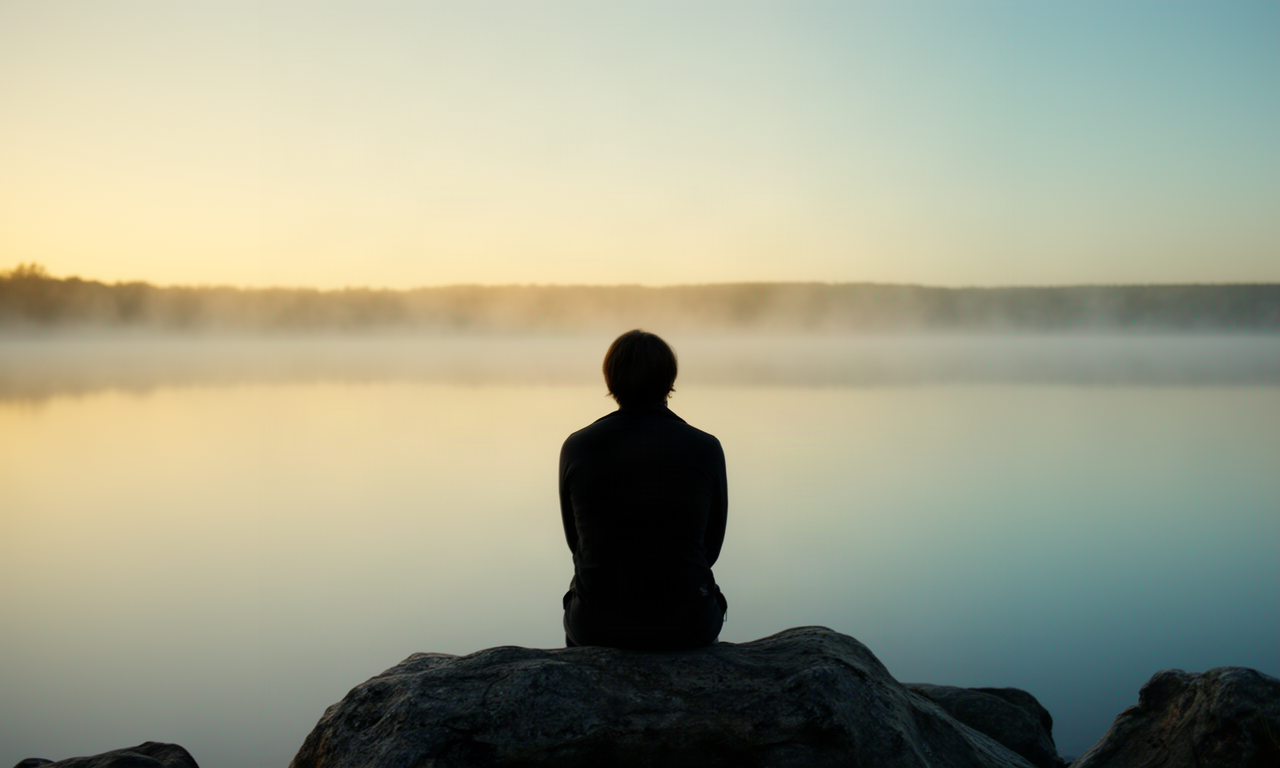
Here’s one small step. Each morning this week, before you pick up your phone, take five minutes to be still. Read Psalm 46 slowly. Tell God honestly what you’re worried about. Then sit quietly and let the words “Be still, and know that I am God” settle over you.
You may not feel different straight away. That’s okay. You’re building a habit of running to him first, before the noise reaches you.
If you’d like a place to start, you could pray something like this:
A prayer for today
Father, the world feels shaky right now, and so do I. Thank you that you are my refuge and strength. Help me to hide in your presence, to trust you with what I can’t control, and to rest in your love today. Fight for me where I can’t fight for myself, and let your peace guard my heart. In Jesus’ name, amen.
And this is only the beginning. The more we come to know God – his character, his holiness, his love – the more our relationship with this world changes. We stop simply waiting for the storm to pass, and begin to stand in it as sons and daughters who know whose we are. That’s where we’re heading together.
The world may keep shaking.
But you don’t have to be shaken with it.